
Pickleball Paddle Grip Size Guide: Handle Length, Control, and Custom Specs
Pickleball paddle grip size and handle length affect control, reach, swing weight, and how comfortable the paddle feels in long rallies. For players, the right handle helps the paddle feel stable without slowing down hand speed. For brands and buyers, grip size is also a product-spec decision: it influences who the paddle fits, how the paddle is positioned, and whether a model works better for beginner sets, club programs, or performance private-label lines.
Looking for a pickleball paddle manufacturer or OEM/ODM partner?
Joying Pickleball is a direct factory for carbon fiber and fiberglass paddles — custom logos, private label, low MOQ, and fast North American shipping. Get a wholesale quote within 24 hours.
If you are comparing paddle samples or planning a custom pickleball paddle order, use handle length and grip circumference together. A small change in either spec can make the same paddle feel faster, more powerful, or easier to control.
Why Pickleball Paddle Grip Size Matters
Most players focus first on paddle weight, face material, core thickness, and shape. Grip size is easier to overlook, but it changes how naturally the player can hold the paddle, rotate the wrist, and control the face angle. A grip that is too large can feel slow and hard to adjust. A grip that is too small may feel unstable unless the player builds it up with overgrip.
For retail brands, clubs, schools, and distributors, this is why grip sizing should be treated as part of the product brief, not an afterthought. A paddle designed for youth programs, beginner bundles, or rental use may need a different handle feel from a performance paddle built for advanced players.
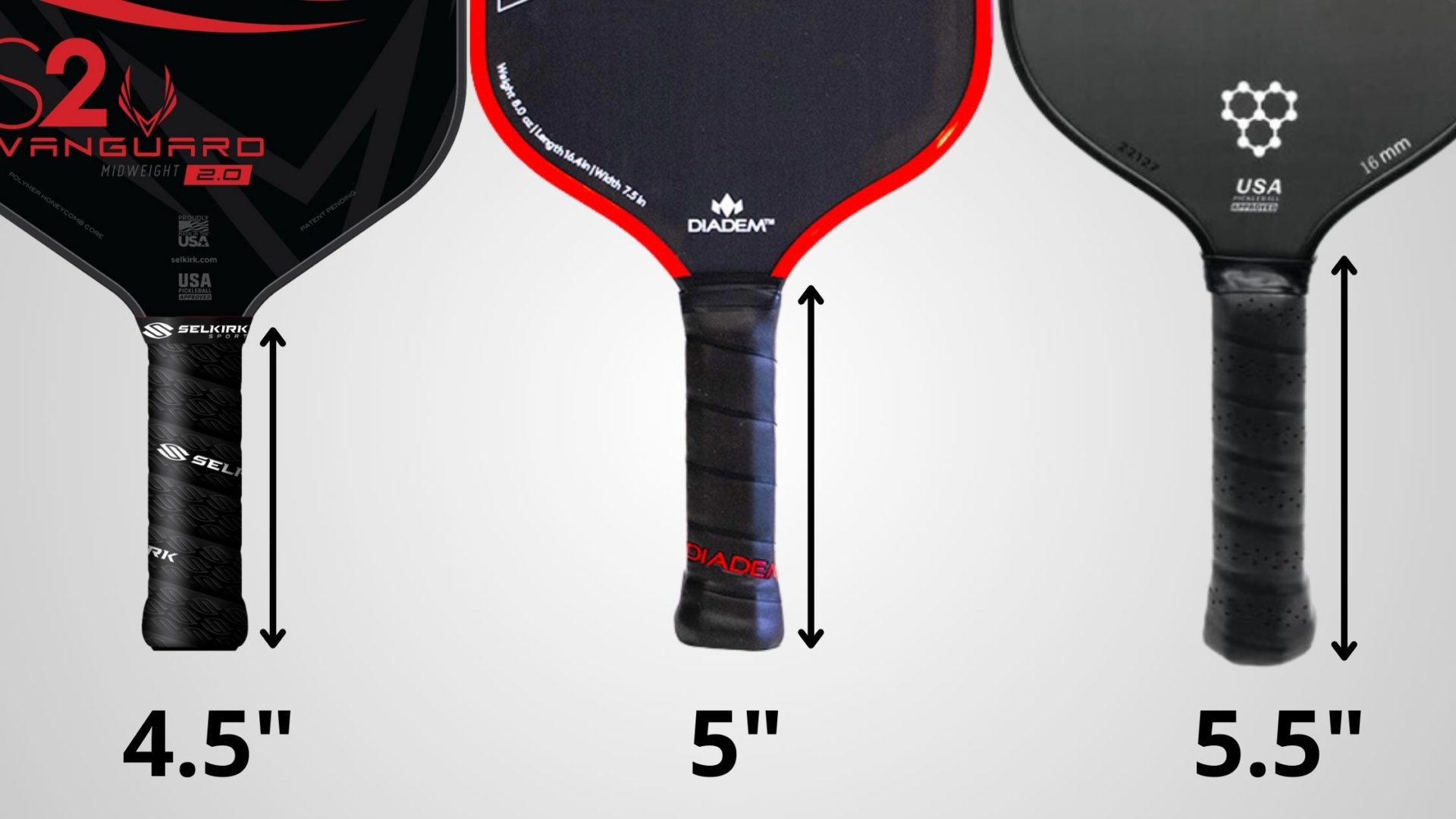
Shorter Handles: Faster Hands and Easier Maneuverability
Shorter handles, often around 4 to 5 inches, usually create a quicker, more compact feel. The paddle can feel easier to move during volleys, blocks, counters, and fast exchanges near the kitchen. This style can suit players who value reaction speed, wrist action, and touch.
The trade-off is leverage. A shorter handle may offer less room for two-handed backhands and can reduce the feeling of easy power on drives or serves. For buyers building beginner or recreational paddle lines, this type of handle can still work well when paired with a comfortable grip circumference and balanced paddle weight.
Longer Handles: More Reach, Leverage, and Two-Handed Backhand Space
Longer handles, often around 5.5 to 6 inches, shift the feel of the paddle. The extra handle length can help players generate leverage, add reach, and fit a two-handed backhand more comfortably. This can be useful for performance paddles aimed at tennis crossover players or players who prefer a stronger baseline game.
The compromise is that a longer handle can make the paddle feel less compact in quick hand battles. When developing a custom paddle, handle length should be balanced with face shape, core thickness, and total weight so the paddle does not feel too slow.
The Common Middle Ground
Many all-around pickleball paddles use a middle handle length around 5.25 inches. This creates a practical balance between quick handling, enough leverage, and broad player comfort. For many private-label programs, this middle-ground spec is a good starting point because it can serve a wider range of players.
From there, brands can test variants: a longer handle for a performance model, a slightly smaller grip for youth or beginner bundles, or a thicker grip feel for players who prefer more stability.
Grip Size vs. Handle Length: What Buyers Should Specify
Handle length is the distance from the butt cap to the paddle face or shoulder. Grip size usually refers to the circumference and feel of the handle in the hand. Both should be included in a sourcing brief.
- Handle length: affects leverage, reach, and two-handed backhand comfort.
- Grip circumference: affects hand comfort, control, wrist movement, and perceived stability.
- Grip material and overgrip: affect sweat absorption, texture, and final feel.
- Butt cap shape: affects hand lock-in and how secure the paddle feels during fast swings.
Custom Pickleball Paddle Specs for Brands and Bulk Buyers
For OEM and private-label pickleball paddle projects, handle specs should be decided before sampling. Joying Pickleball can help brands compare handle length, grip circumference, overgrip options, and paddle balance so the final product matches the intended audience.
Planning a custom paddle line? Send your target player type, price range, material preference, and expected order quantity. We can help recommend handle and grip specifications for beginner sets, club paddles, wholesale programs, or performance private-label paddles.
Explore custom pickleball paddle manufacturing options or request a paddle specification quote.
FAQ: Pickleball Paddle Grip Size and Handle Length
What is the standard pickleball paddle handle length?
Many all-around paddles use a handle length near 5 to 5.25 inches, while elongated or performance paddles may use longer handles around 5.5 inches or more.
How do I choose pickleball paddle grip size?
Choose a grip that lets the hand feel secure without limiting wrist movement. If the grip feels too small, players can build it up with overgrip. If it feels too large, it is harder to reduce after production.
Does handle length affect pickleball paddle control?
Yes. Shorter handles often feel quicker and easier to control in fast exchanges, while longer handles can add leverage and reach but may feel slower for some players.
Can pickleball paddles be customized with different grip sizes?
Yes. For OEM and private-label production, brands can specify handle length, grip circumference, grip material, butt cap style, and overgrip options during sampling.
Pickleball Brand & Sourcing Guides
Building or sourcing your own paddle line? These in-depth guides cover the strategy and manufacturing behind a successful pickleball brand:
- OEM Pickleball Paddle MOQ, Tooling & Sampling: The Process Explained
- How to Start a Pickleball Paddle Brand (OEM/ODM Guide for 2026)
Ready to talk specifications and MOQ? Request a custom paddle quote → or contact our sourcing team.
Pickleball Grip Size Chart
| Grip Size | Circumference | Suitable Hand Length | Handle Length | Feature |
|---|---|---|---|---|
| 4.0″ (Small) | 4.0 in | < 6.5″ | 5.0–5.25″ | Flexible, easy on the wrist; for small hands / women |
| 4.25″ (Medium) | 4.25 in | 6.5–7.5″ | 5.25–5.5″ | Most versatile, balanced |
| 4.5″ (Large) | 4.5 in | > 7.5″ | 5.5–5.75″ | Stable, more power; for large hands / power players |
Full paddle dimensions (USAP compliant): total length ≤ 17.0″, width ≤ 7.0″, edge circumference ≤ 16.0″.
Handle length effect: longer handle → higher swing weight, more reach, more spin; shorter handle → quicker at net, less wrist strain.
Frequently Asked Questions
Q: What is a standard pickleball paddle grip size?
A: The most common is 4.25″ (medium). Small hands use 4.0″, large hands 4.5″. Confirm by feel using the size chart above.
Q: How do I measure my pickleball grip size?
A: Open your hand and measure from the crease at the base of your ring finger to the tip of your middle finger — that is your grip circumference in inches. Or press your index finger to your palm and measure from its base to the middle-finger tip. Match to 4.0 / 4.25 / 4.5″ on the chart.
Q: What happens if my grip is too small or too big?
A: Too small slips easily and forces wrist compensation; too large is hard to control and tiring over time. A correct grip: web of hand fits the throat, four fingers neither overlap nor float.
Q: Does handle length affect paddle performance?
A: Yes. A longer handle raises swing weight, reach and spin; a shorter handle is quicker at net and easier on the wrist. OEM can spec 5.0–5.75″ per playing style.
Q: What are the standard pickleball paddle dimensions in inches?
A: USAP compliant max: total length 17.0″, width 7.0″, edge circumference 16.0″. Common sizes are 16×8″ or 16.5×7.5″.
Q: Is a longer pickleball paddle handle better?
A: Beneficial for doubles defenders / power players; net-rush singles players prefer shorter. There is no absolute best — choose by court position and feel.
Q: Can I customize grip size and handle length for OEM/ODM?
A: Yes. Joying supports grip circumference (4.0/4.25/4.5), handle length (5.0–5.75″), wrap and weighting. MOQ from 100, with samples to confirm feel.
Q: What grip size do pro players use?
A: Most pros use 4.25″; some power players use 4.5″ or add weighting. For recreational players: set a base circumference by hand length, then fine-tune handle length.
\n