
Start with the experience, then define the construction
Two paddles described as full-foam can feel noticeably different. One player may describe a paddle as muted and cushioned; another may call a different model crisp or lively. Those impressions are useful development inputs, but the word foam does not explain them on its own.
For private-label paddle development, the practical task is to translate the preferred experience into a complete specification and a repeatable sample evaluation. A core trade name, a thickness and a carbon-fiber grade are not enough to reproduce the finished product’s response.
Foam describes a material structure, not one fixed behavior
Polymer chemistry, formulation, density, cell structure and processing can differ between foams. Material-family labels and proprietary names also describe different levels of information. A commercial term should not be treated as a complete chemistry specification, nor assumed to mean the same thing across suppliers.
Ask for the underlying material identification where available, density and dimensional tolerances, a hardness method, and relevant mechanical data. Hardness figures are only comparable when the scale, specimen conditions and method are compatible. Density alone does not define impact feel, and a preferred material coupon does not guarantee a preferred paddle.
HUDEF’s SXD article provides an example of a manufacturer publishing core specifications alongside its product story. Those are supplier disclosures, not independent confirmation of finished-paddle performance. They demonstrate the kind of information a buyer can request without establishing that one formulation is universally better. Source: HUDEF.
Face construction changes the assembly
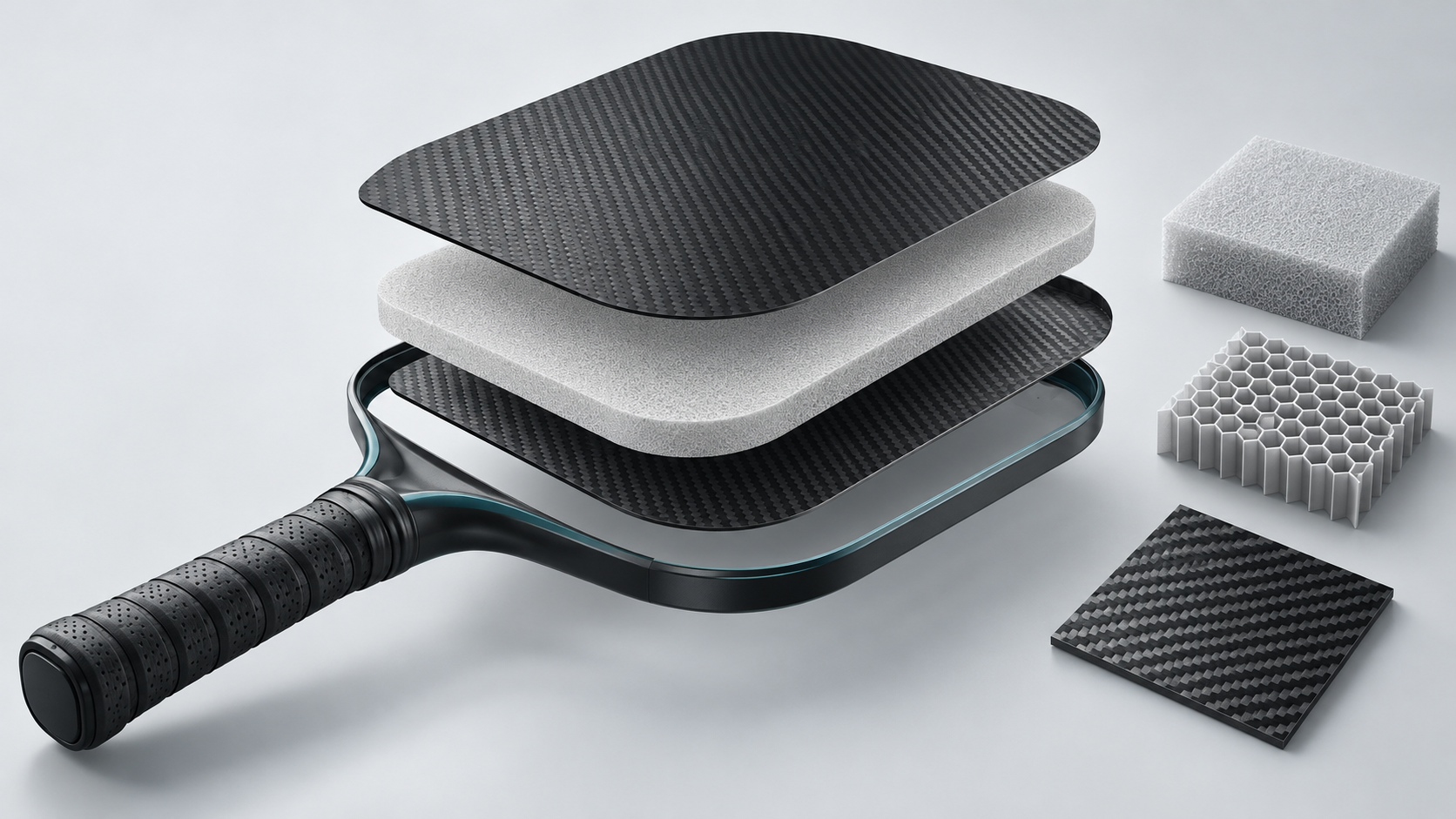
The face is part of a layered structural system. Fiber arrangement, resin, layer thickness and the connection to the core can affect how that system deforms and responds. A label such as T700 identifies a fiber grade; it does not describe the entire laminate or determine a paddle’s power, control or durability by itself.
For development comparisons, record the face schedule under an agreed confidentiality arrangement, or at least define a controlled construction revision. If both the foam and face are changed between samples, a player preference cannot confidently be attributed to the foam. Testing one variable at a time, where feasible, makes feedback more useful.
The same caution applies to thickness. A 14mm paddle is not automatically more powerful, firmer or faster than every 16mm paddle. The result depends on the complete build. Thickness should be a documented design variable, rather than a substitute for measuring the sample.
Bonding, edges and internal supports matter too
The joint between face and core transfers load through the assembly. Adhesive selection, surface preparation and processing therefore belong in the development record. Perimeter materials and internal supports may also change the response away from the center of the face.
Gearbox’s Pressure X description explicitly combines a carbon structural system with foam and other tuning features. It is a useful example of a foam-containing paddle whose behavior is presented as a system-level design, rather than a property of foam alone. Its published performance statements remain manufacturer claims unless independently tested. Source: Gearbox.
Control mass and balance before judging feel
A change in mass distribution can alter how a paddle handles even when its material description remains the same. Record finished mass, balance point, grip dimensions and, where available, swing and twist inertia using a specified method. Compare samples within agreed ranges, or disclose differences when they cannot be matched.
Otherwise a player may prefer the handling of a lighter sample and describe that preference as a softer core. This is a reason to combine subjective feedback with basic measurements, not a reason to dismiss player testing.
Test across relevant conditions
Foam response can vary with temperature. Zotefoams’ technical guidance explains that elevated temperature can change dimensions and mechanical properties, with behavior dependent on polymer type and exposure. This is general material guidance; it does not establish the operating limits of any pickleball paddle. Source: Zotefoams TIS28.
Choose conditioning conditions appropriate to the intended market, and document the temperature, duration and recovery before evaluation. A brief material exposure at an extreme temperature does not prove that the finished paddle is safe to store or use there. Validate the assembled product, including adhesive, grip and edge components.
Build a useful sample matrix
| Development question | Controlled comparison |
|---|---|
| Is the preferred response related to the core? | Compare core variants while holding the face, shape and target mass distribution as consistent as practical |
| Is the face too lively or too muted? | Compare controlled face revisions on the same core platform |
| Does handling affect the preference? | Record mass, balance, grip and inertia alongside player scores |
| Does the response change with use? | Evaluate baseline and defined exposure checkpoints |
| Can production reproduce the sample? | Repeat checks on multiple normal production specimens and lots |
Use coded samples and consistent balls, courts and drills where possible. Ask players to score specific tasks: soft resets, counters, drives and off-center contacts. Separate perceived vibration, sound, effort and controllability instead of asking only whether the paddle feels good. A small panel helps guide design; it does not prove a universal player preference.
Before freezing a design, agree which measurements and sample attributes are critical, who approves changes, and how the approved reference will be retained. For related specification choices, read our paddle construction guide. Include your target player, reference sample and preferred response in a development inquiry, so the project starts with a testable brief.
Source and editorial notes
Sources reviewed October 23–24, 2026. The sample matrix is a proposed development process, not a claim that JOYING has tested the named products. Material data, manufacturer descriptions and player preferences serve different purposes and should not be combined into an unsupported performance ranking.