
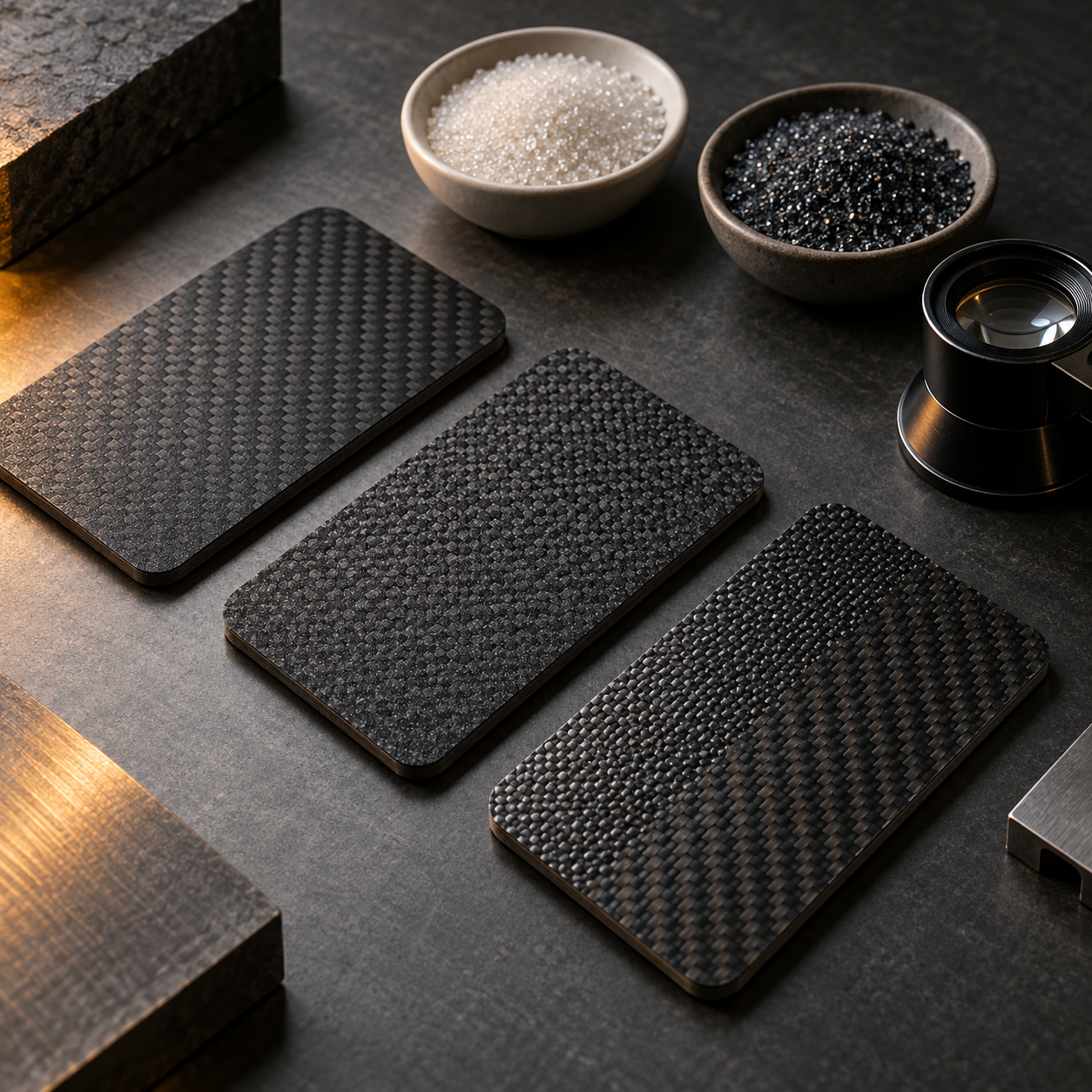
“Durable grit” is often discussed as if the mineral name settled the question. It does not. A paddle face is a system: a carbon-fiber or other face layer, a textured foundation, particles where used, a binder that holds them, and a process that determines how consistently the surface is reproduced. A very hard particle can still shed if the binder or interface fails. A well-bonded coating can still lose the ball interaction a brand intended to preserve.
For an OEM buyer, the practical task is to specify the surface response and its acceptable change over use, then compare material systems under the same protocol. This guide concentrates on material selection; our separate surface-wear testing guide explains how to document the exposure and results.
Start with the whole surface, not a hardness ranking
Silicon carbide (SiC) is hard and sharp, while common fused aluminum oxide (alumina, Al₂O₃) is generally tougher in coated-abrasive applications. Some engineered ceramic alumina grades are designed to wear differently from commodity alumina. These are useful starting properties, but the comparisons come largely from industrial cutting and grinding. A pickleball impact places different loads on particles embedded in a paddle coating, so a grinding-product life ranking cannot be transferred to paddle spin or service life. Norton's SiC product description and 3M's mineral comparison describe the underlying material distinction, not paddle test results.
| Candidate surface route | Material-selection reason | Main question for the paddle program |
|---|---|---|
| SiC particles in a coating | A hard, sharp grain offers a route to a pronounced microtexture. | Do the selected grain size and binder retain the intended texture without particle loss or excessive initial spin? |
| Conventional fused alumina particles | A generally tougher grain family offers another balance of particle fracture and retention. | Does the specific grade, shape and loading achieve the required ball interaction after wear? “Alumina” alone is not a complete specification. |
| Engineered ceramic alumina particles | Controlled grain structure creates a distinct formulation route from commodity fused alumina. | Does the grade justify its added process complexity in this paddle coating? Grinding claims cannot answer that question. Norton material overview. |
| Textured face without added loose grit | A useful control for separating the effect of the base texture from an added-particle layer. | Does the textured face meet the product brief without the process complexity of a particle coating? |
This is a screening matrix, not a ranking. Neither mineral hardness nor a supplier’s “grit number” specifies finished-surface spin retention.
Specify the particle and the bond together
For a meaningful quotation, ask suppliers to identify the particle chemistry and grade; particle-size distribution rather than only a nominal mesh; shape or angularity; target coverage; binder chemistry; coating sequence; cure conditions; and finished coating thickness. Then agree which parameters are controlled at incoming inspection and at batch release. A change in particle supplier or resin can change the surface even when the marketing name stays the same.
The particle must be anchored to the substrate. In coated abrasives, manufacturers distinguish a base or “make” coat that fixes the grain from a later “size” coat that reinforces it. This is an analogy for evaluating retention, not a prescribed paddle construction: a paddle coating may use a different process. The useful question is still where the particle is embedded, what holds it there, and what remains after repeated ball impacts and cleaning. Norton Abrasives explains the make/size-coat functions.
Grain size and coverage create trade-offs. More exposed or larger particles may change initial contact, but can also increase coating stress, shed differently or push a new sample outside the target certification window. Excessive binder over the particles can hide the intended texture. These are engineering hypotheses to test on the actual paddle; there is no universal “best” size or loading.
Use current paddle rules as design constraints
USA Pickleball announced that paddles submitted for certification from October 1, 2026 must measure 2,100 RPM or less in its spin-rate test. It replaced the upper roughness and coefficient-of-friction thresholds with measurements of record for that process. This applies to submissions under USA Pickleball’s program; it does not make a hard or durable coating automatically compliant, and older approvals follow the standards applicable at certification. Check the current USA Pickleball notice and the exact branded model before making an approval claim.
UPA-A is a separate certification system for its applicable professional events. Its current Paddle Specifications and Testing Requirements, version 26.6 require approved models to maintain the construction and characteristic performance of the submitted samples. The same document restricts face modifications that increase spin, including the application of grit or resin. A material substitution or coating-process change therefore needs a certification review, not just a cosmetic sign-off.
Recent brand pages show why buyers are asking about these systems. Luzz describes a SiC-grit Cannon XPP face; SENS describes a textured foundation, SiC particles and a protective layer on the ATRA 700. Those descriptions establish what the brands claim to use. They do not establish a transferable particle specification, independent wear result or license to copy a particular coating architecture.
Qualify the formulation before selecting a claim
Use a staged comparison. First, screen candidate coatings on representative face coupons for uniformity, particle retention, visible cracking and adhesion. A standard abrasion method such as ASTM D4060-25 can compare organic coatings under controlled conditions, but it is not a pickleball spin test or a conversion to “months of play.” ASTM itself notes that dense fillers and abrasive-wheel behavior can complicate comparisons.
Next, build full paddles with the same face and support structure intended for production. Record new-paddle spin under a defined method, repeat after a documented wear exposure, and inspect the face by consistent imaging. Compare individual results and variation across lots, not only the best sample. The objective is to understand the direction and spread of change: a coating that becomes rougher during use can be as important to investigate as one that smooths. UPA-A has specifically discussed roughness increases on some newer durable-grit technologies in its 2027 surface-roughness ABI guidance. That guidance is a future program consideration, not evidence that any named material behaves this way.
For production, keep the approved particle and binder sources, formulation revision, cure record, surface images, sample identifiers and lot-level checks together. The brand should set acceptance criteria from its own validated design and target market. A supplier should not promise a fixed spin-retention percentage, injury reduction or certification from mineral choice alone.
An RFQ that produces comparable samples
Ask each candidate supplier for:
- Particle grade, chemistry, size distribution and proposed loading or coverage.
- Face substrate, surface preparation, binder, cure and finishing route.
- Target finished texture, coating thickness and appearance tolerance.
- Coupon and full-paddle inspection methods, including particle loss and adhesion checks.
- New and post-wear ball-interaction results from the same stated method, with individual samples and lot IDs.
- The process changes that would trigger resampling or a new certification submission.
The strongest material decision is the one the brand can reproduce in production and defend with an agreed test record. Joying can review the target market, face construction and intended surface claim with OEM buyers during paddle development. Final branded models require the relevant testing and approval; this article is an engineering selection framework, not a certification result or freedom-to-operate opinion.
Editorial and source notes
Sources reviewed October 28, 2026. No Joying laboratory results or comparative coating performance are claimed here. Industrial abrasive references explain material properties and binder principles; they are not paddle-specific evidence. Brand product descriptions are identified as brand claims. Always verify current certification requirements and the exact model at the time of submission.