
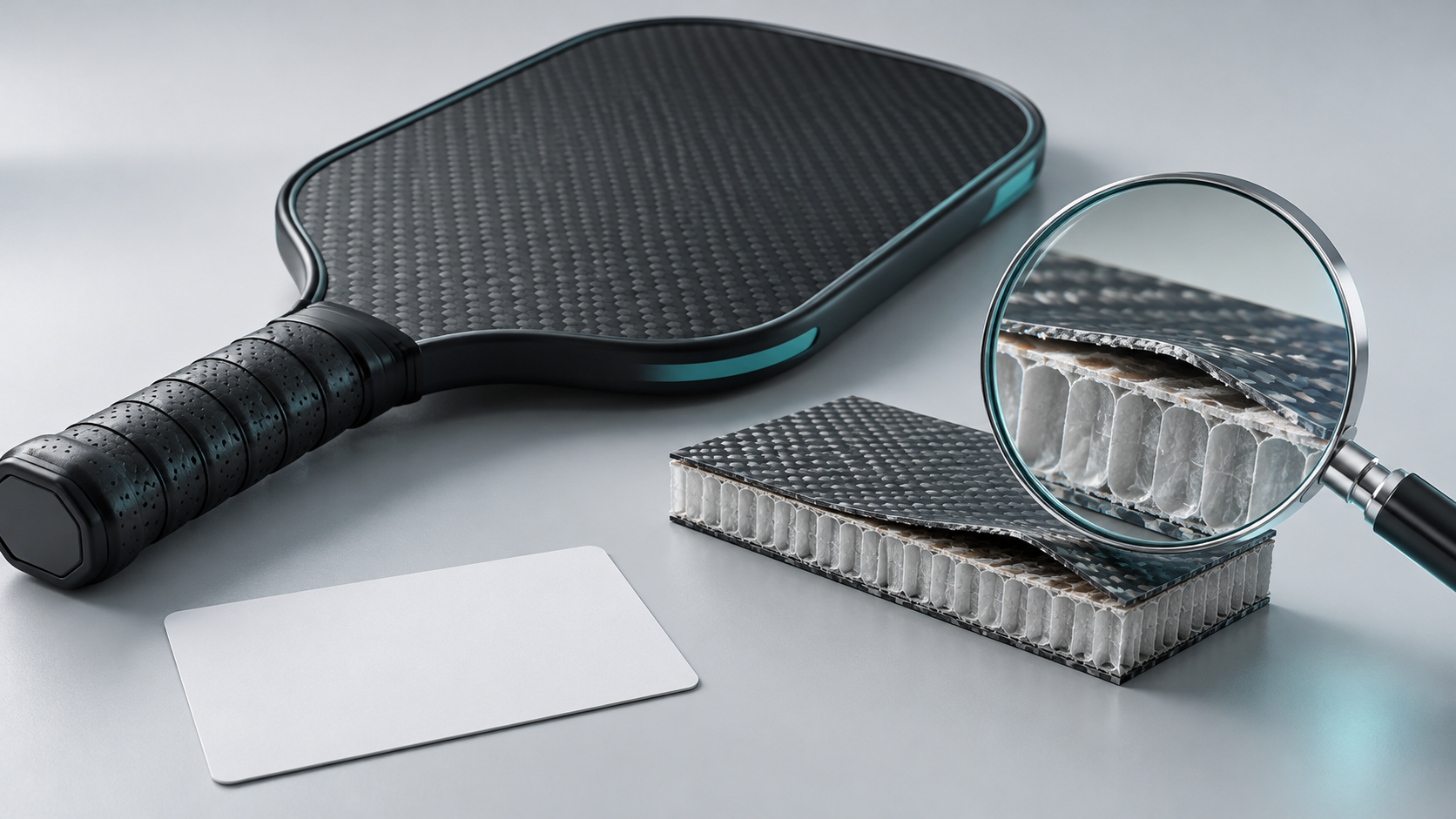
A different core does not eliminate every interface
Yes, a foam-containing paddle can experience separation at a bonded interface. Replacing a honeycomb core with foam changes the construction, but it does not by itself prove that every face, joint and perimeter connection will remain intact throughout use. The actual architecture must be examined; not all foam paddles share the same interfaces.
For a brand placing an OEM or ODM paddle order, the useful questions are which failure mechanisms are relevant to that construction, how they will be evaluated, and who will handle a substantiated customer claim. These questions belong in development and purchasing discussions before a batch ships.
Use the right name for the observed problem
Players may use terms such as dead spot, core crush and delamination interchangeably. A complaint is a starting observation, not a confirmed diagnosis. Clear terminology helps the buyer and supplier investigate without assuming a cause.
| Observation or mechanism | What it does—and does not—tell you |
|---|---|
| Face-to-core separation | A local loss of attachment between layers; its cause still requires investigation |
| Core damage or permanent deformation | A change within the core; this should not automatically be called an adhesive failure |
| Laminate separation | Separation within a layered face; distinct from the face releasing from the core |
| Surface wear | A change at the hitting surface; not by itself proof of structural failure |
| Rattle or changed sound | A symptom worth documenting, but insufficient on its own to identify the defect |
Inspection may require comparison with retained samples, controlled mechanical checks or destructive analysis by a competent investigator. Record the initial condition before opening or cutting a returned product. A damaged return cannot always reveal when or why the damage began.
Define durability as a set of requirements
“Lasts one year” is incomplete without describing the use, environment and performance endpoint. A warranty period is also not an engineering prediction that every paddle will maintain unchanged performance for that period.
Define the intended use profile, storage instructions and unacceptable changes. Relevant development questions may include repeated-impact response, interface integrity, dimensional stability and surface-performance retention. Choose methods and limits appropriate to the actual construction; there is no universal cycle count in this article that establishes service life.
Material coupon tests help isolate behavior, while assembled-paddle tests evaluate the system. Neither should automatically replace the other. Agree sample selection, conditioning, exposure, measurement and reporting before the test starts, and preserve individual results rather than only an average.
Compression-set data need their conditions
Compression set describes residual deformation after a specified compression and recovery procedure. A percentage without its method, compression level, duration, temperature and recovery time is difficult to interpret. Rogers’ material guidance highlights these comparison conditions and explains that calculation methods can differ. This is general foam-testing guidance, not a paddle-specific acceptance standard. Source: Rogers.
For a paddle project, ask the laboratory to select a method suitable for the material and purpose. Do not apply results from an unrelated foam grade to the supplied core. A good material result also does not establish the integrity of the bond in the finished paddle.
Include environmental exposure and production variation
Temperature can change foam properties, and exposure conditions matter. Zotefoams’ technical sheet describes dimensional and mechanical changes at elevated temperatures. Its data are material-specific and cannot establish the safe storage temperature of a different finished paddle. Source: Zotefoams TIS28.
Set conditioning conditions from the expected transport, storage and playing environment. Evaluate the complete assembly after exposure and any agreed recovery period. Document whether a change is temporary or persists after conditioning. Do not turn a short extreme-temperature screening test into an unrestricted consumer operating claim.
Repeat qualification on representative production specimens, and control changes to core grade, adhesive, face materials and processing. Keep a traceable link between the approved reference, production lot and any later complaint. This makes it possible to investigate whether an issue is isolated or associated with a particular batch without guessing from online reports.
Write an operational warranty schedule
The agreement should distinguish commercial responsibilities between buyer and supplier from the brand’s obligations to its customer. Consumer rights depend on the market and cannot be assumed to disappear because an OEM contract assigns costs differently.
Before ordering, resolve:
- The covered defects, exclusions, territories and start of the relevant periods.
- Evidence needed for a claim: order details, serial or lot identification, photographs and use history.
- Who authorizes returns and whether a sample must be preserved for analysis.
- Who pays investigation, return freight, replacement freight and handling.
- Response timelines, remedies and the process for repeated or batch-related issues.
- How customer-facing statements remain consistent with the tested product and applicable obligations.
CRBN’s public policy illustrates why scope matters: its limited warranty identifies manufacturing defects and workmanship, geographical conditions and exclusions. A headline warranty duration alone does not communicate all of those terms. A different brand must define its own policy rather than copying another company’s wording. Source: CRBN warranty policy.
Close the loop after a complaint
Classify the observation, preserve evidence and compare it with the specification and retained samples. Separate an immediate customer remedy from the longer root-cause investigation where necessary. Track confirmed findings and corrective actions, then decide whether the design, process or instructions need revision.
Avoid using unverified forum complaints to calculate a failure rate or accuse a competitor. Equally, do not dismiss a complaint simply because the paddle uses foam. A useful quality system connects evidence, decisions and follow-up.
For the construction choices behind these risks, read our paddle construction guide. Include your durability requirements, sales markets and proposed claim-handling process in a project inquiry so validation and commercial responsibilities can be discussed together.
Source and editorial notes
Sources reviewed October 23–24, 2026. The validation and warranty workflow is a proposed procurement framework, not a report of JOYING product testing or a jurisdiction-specific legal opinion. No universal service life, failure rate or guarantee of zero delamination is asserted.