
The 2026 paddle conversation is full of terms such as Gen 4, full-foam, foam-edge, thermoformed, unibody and dual-zone core. These terms can be useful, but they do not all describe the same thing.
The most important distinction for an OEM buyer is simple:
Full-foamusually describes the core architecture: engineered foam occupies all or most of the intended core area.Thermoformedusually describes a forming and bonding process or a construction architecture made under heat and pressure.
A product can therefore be full-foam and thermoformed at the same time. A thermoformed paddle does not automatically have a full-foam core, and a full-foam paddle does not automatically have the same perimeter, face or cure process as another full-foam model.
The right purchasing decision comes from the cross-section and the validation record, not from the generation number printed in a headline.
What Gen 4 means in the market
Gen 4 is a market term, not a universal technical standard. Different brands may use the term for different combinations of foam core, perimeter design, face material and forming process. An industry explainer published in 2026 also notes that the generation labels are not governed by a single equipment body.
For product development, replace the label with measurable questions:
- What is the core material and where is it located?
- Is the foam full-area, perimeter-only or combined with honeycomb?
- How are the face and edge bonded?
- What is the nominal thickness and tolerance?
- How are weight and balance controlled?
- What surface and durability checks are performed?
- Which claims apply to this exact model and sample revision?
The main construction families
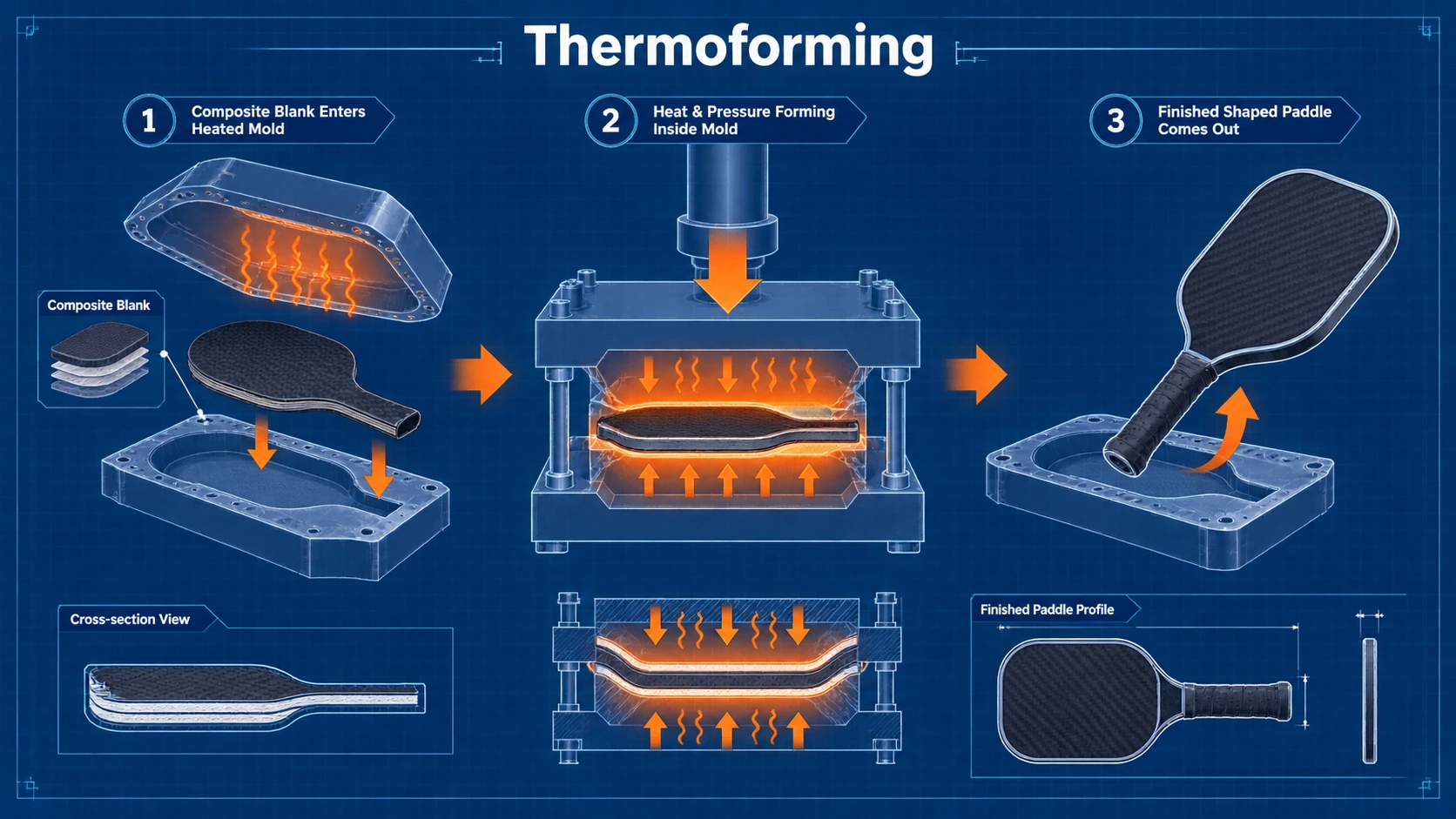
Suggested caption: Thermoforming is a forming and bonding route. The exact core, face layup and edge construction must still be specified for each model.
| Construction term | What it generally describes | What it does not prove |
|---|---|---|
| PP honeycomb | A cellular polypropylene core | A specific level of control, power or durability |
| Foam-edge | Foam added around the perimeter of another core | That the paddle is full-foam |
| Full-foam | Foam occupying all or most of the core area | A universal density, rebound, lifespan or feel |
| Thermoformed | Heat and pressure used to form or bond a defined assembly | That every thermoformed paddle has the same core or performance |
| Unibody | A continuous-looking face/perimeter construction | A specific material grade or official approval |
| Gen 4 | A market-generation label | A standardized construction or test result |
This vocabulary prevents a common sourcing mistake: asking for a “Gen 4 paddle” without defining what the factory must actually build.
Full-foam: what an OEM buyer should inspect
A full-foam program should identify the foam system, the intended density or hardness range where relevant, the thickness, the face materials and the edge/perimeter design. The foam may provide a different impact response from a honeycomb core, but the final result still depends on the face, bonding, geometry and mass distribution.
Important checks include:
- Cross-section confirmation of the foam area.
- Foam density or other agreed material property, with a stated test method.
- Core thickness and dimensional tolerance.
- Face layup, resin and surface finish.
- Bonding between face, foam and handle/throat structure.
- Edge protection and local reinforcement.
- Static weight, balance and swing response.
- Repeated-impact or compression durability method.
- Sound, vibration and feel evaluation under a defined sample protocol.
Avoid writing “full-foam means no dead spots” or “full-foam never loses pop.” Those statements are not a substitute for a model-specific durability record. The correct product claim should match the evidence collected for the exact construction.
Thermoformed: what the process changes
Thermoforming can join or shape the face, core, perimeter and edge into a defined assembly under heat and pressure. The value of the process depends on the mold, materials, temperature/pressure window, cooling, trimming and inspection. The word itself does not specify how much foam is present or how the face is laid up.
For a thermoformed sample, ask for the process flow and the control points that matter to the model:
- Mold and outline revision.
- Material stack before forming.
- Heating, pressure and dwell controls as appropriate to the project.
- Cooling or post-forming handling.
- Edge trimming and edge inspection.
- Thickness, weight and balance checks after forming.
- Face texture and visual inspection.
- Bonding or delamination checks.
The factory does not need to publish proprietary machine settings in a public article. It does need an internal process record that makes the approved sample repeatable.
Why the two terms are often combined
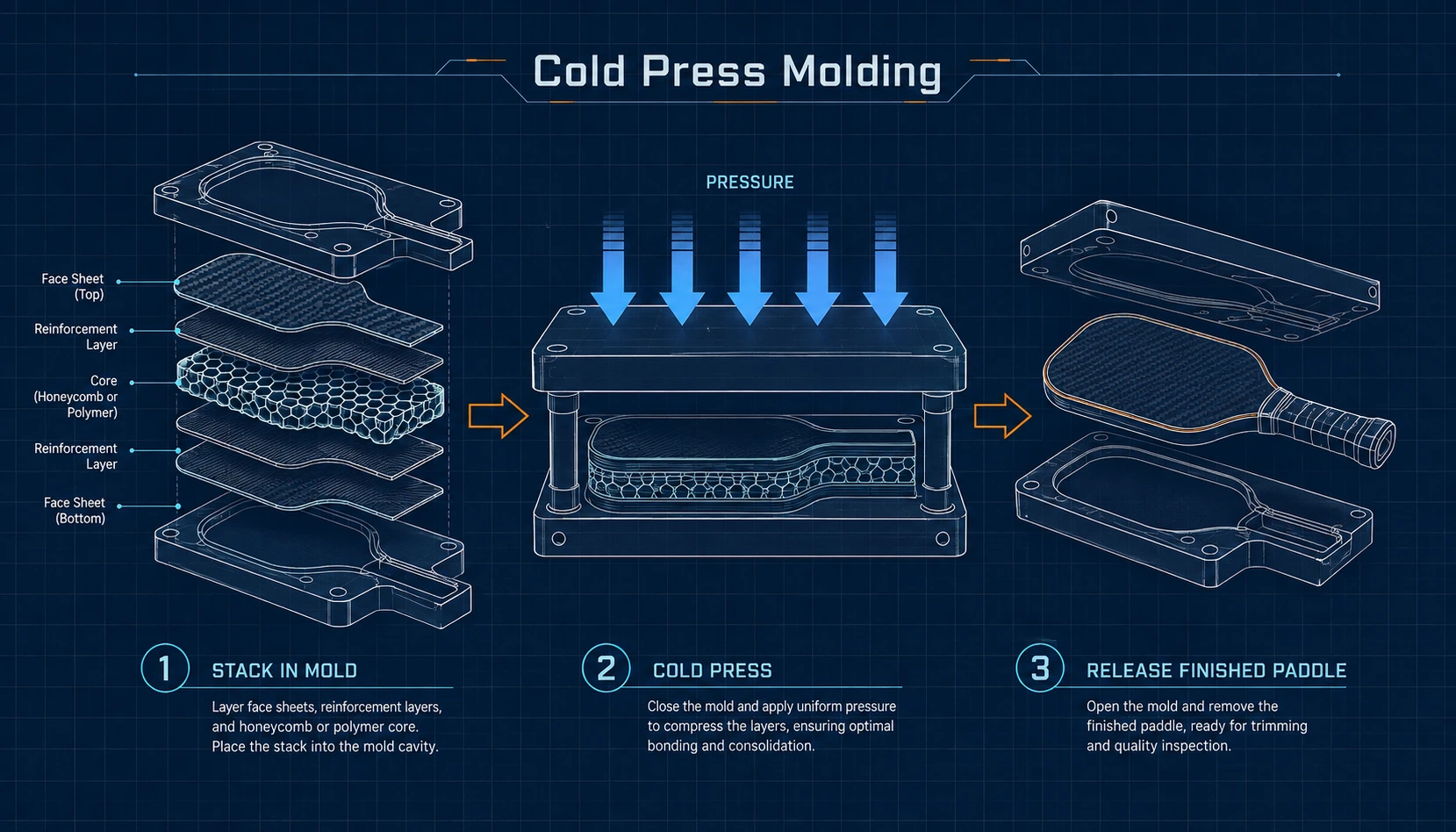
Suggested caption: A cold-press illustration helps separate the process axis from the core-material axis; use the actual approved cross-section for a production claim.
Full-foam can be used as the core architecture inside a thermoformed or otherwise formed assembly. This combination is one reason the 2026 market discussion often treats the two terms as if they were synonyms. They are not.
Think in two axes:
- Core axis: honeycomb, foam-edge, hybrid foam, or full-foam.
- Process axis: cold-pressed, thermoformed, injected, bonded or another documented assembly route.
Then add the face, surface, thickness, shape and mass distribution. This framework gives a buyer a product specification that can be compared across factories.
The performance variables that should be measured
Static weight and balance
Static weight is easy to publish but incomplete. A head-heavy paddle and a handle-heavy paddle can have the same mass and feel different in motion. Record the target weight range, balance point and the method used. If the line is positioned around swing weight or MOI, define the instrument and test method before comparing samples.
Thickness and geometry
Nominal 14 mm or 16 mm language needs a tolerance and measurement location. Shape also changes the usable face area, reach, balance and target user. Keep the outline revision with the sample record.
Face and texture
Core architecture and surface texture solve different problems. Raw carbon, peel ply, spray grit and other finishes should be evaluated for consistency, wear and cleaning requirements. A new-sample spin result should not be treated as a permanent life-cycle promise.
Edge and bonding
Inspect the perimeter, edge guard or unibody wrap, transitions near the throat, and any visible gaps or wrinkles. A visually clean face does not prove that the bond or edge will remain consistent in production. Define inspection criteria before approving the sample.
Durability and compliance
Use a test plan that matches the product’s target market and claims. If the model is intended for sanctioned play, use the current official rules and submission resources. USA Pickleball’s manufacturer resources describe checks including dimensions, coefficient of friction, deflection, reflection/gloss and roughness; an internal factory test can support development, but official certification remains a separate process.
A closed-loop OEM validation process
Stage 1: Define the product platform
Write the target buyer, channel, price position, shape, thickness, face, core, texture, handle, grip and packaging. State which parts are fixed and which parts may be evaluated during sampling.
Stage 2: Select a documented construction
Do not order only “a Gen 4 paddle.” Specify full-foam or another core structure, forming method, face material, texture method and edge design. Ask the factory to flag any field that cannot be confirmed before sampling.
Stage 3: Build and inspect samples
Use a sample code and revision. Photograph the face, edge and handle. Record dimensions, weight, balance, thickness, grip, artwork and packaging. Retain the material declaration and any test reports tied to that sample.
Stage 4: Run the agreed test matrix
At minimum, compare dimensions, weight, balance, thickness, face/edge condition, bonding, artwork and packaging. Add surface, deflection, rebound, durability, sound or vibration checks when those attributes are part of the product claim.
Stage 5: Sign the golden sample and tolerances
The approved sample is not just a photograph. It is a specification record with measurable tolerances and a list of approved materials and processes. Note any acceptable cosmetic variation separately from a functional deviation.
Stage 6: Release the first production article
Inspect the first production article against the golden sample before the full run. If the face, core, edge, texture, weight or packaging changes, stop and issue a new revision. This prevents a cheaper or different construction from being silently substituted.
Stage 7: Monitor batch consistency and reorders
Retain lot information, inspection results, nonconformance actions and shipment records. On a reorder, compare against the same revision and do not approve by title alone. Customer feedback about softening, edge damage, texture wear or balance should feed into the next design review.
What the 2026 market signal means for brands
The market is not moving in only one direction. Some current launches emphasize foam-core systems, adjustable mass distribution and all-court consistency rather than maximum power alone. Selkirk’s June 2026 OMNI announcement is one visible example: it describes a premium foam-core paddle, a dual-ring core and adjustable MOI tuning for an all-court positioning.
For a private-label brand, the lesson is not to copy a competitor’s feature name. The lesson is to decide whether the product line needs:
- A control-oriented model with stable response.
- A power-oriented model with a defined weight and balance target.
- A forgiving widebody or a reach-oriented elongated shape.
- A full-foam platform, foam-edge platform or a conventional honeycomb platform.
- One hero construction with several graphics, or several platforms for different buyer segments.
The specification and validation process should support that decision.
RFQ checklist for full-foam or thermoformed programs
Send these fields with the first inquiry:
- Target market, channel and player segment.
- Core architecture: full-foam, foam-edge, hybrid or PP honeycomb.
- Forming route: thermoformed, cold-pressed or another defined process.
- Face material, layup and surface finish.
- Shape, dimensions and nominal thickness.
- Target static weight, balance and measurement method.
- Handle length, circumference and grip.
- Edge or perimeter design.
- Durability and surface tests required.
- Artwork, packaging, carton marks and barcode fields.
- Sample revision, golden-sample sign-off and first-article approval.
- Expected quantity range and reorder plan, quoted for the specific project.
Review the current foam core pickleball paddle options and thermoformed paddle options, then use the OEM and ODM manufacturing page to send a construction brief for a model-specific review.
FAQ
Is every Gen 4 paddle full-foam?
No universal authority defines the label. Many products use Gen 4 to describe a full-foam or foam-heavy construction, but the exact core and perimeter need to be confirmed for each model.
Is every thermoformed paddle Gen 4?
No. Thermoformed describes a process or construction route. A thermoformed paddle may use a PP honeycomb core, foam-edge construction, hybrid layers or another documented architecture.
Which is more durable, full-foam or thermoformed?
There is no responsible universal answer. Durability depends on the specific foam, face, bond, edge, process controls, usage and test method. Compare model-specific evidence instead of making a category-wide promise.
What is more important for an OEM buyer than the Gen label?
The complete construction record, measurable sample tolerances, test method, first-article release gate and batch consistency plan. Those records make the product repeatable.
Conclusion
Full-foam and thermoformed are useful terms, but they answer different technical questions. Full-foam describes the core direction; thermoforming describes how a defined assembly is formed or bonded. A commercially reliable paddle program connects the two to the face, edge, geometry, mass distribution, surface, testing and production records.
For a strong OEM launch, define the construction first, validate the sample second, and approve production only when the first article matches the agreed specification.
Sources and further reading
- Selkirk OMNI product announcement, June 2, 2026: https://www.selkirk.com/pages/press-releases/selkirk-sport-unveils-the-omni-a-new-standard-for-all-court-pickleball-paddles
- 2026 terminology overview and the non-standard nature of generation labels: https://pickld.com.au/blogs/news/foam-core-thermoformed-gen-4-pickleball-paddles-explained
- USA Pickleball manufacturer test resources: https://equipment.usapickleball.org/manufacturers-paddle-page/
- USA Pickleball equipment resources: https://equipment.usapickleball.org/