
“We want a quicker paddle at the kitchen line, but it still has to feel stable on off-center blocks.” That is a useful product brief in conversation. Before a factory can quote or build to it, both teams need to agree on what the player experiences today, how to evaluate a change, and which features of the reference paddle should carry over.
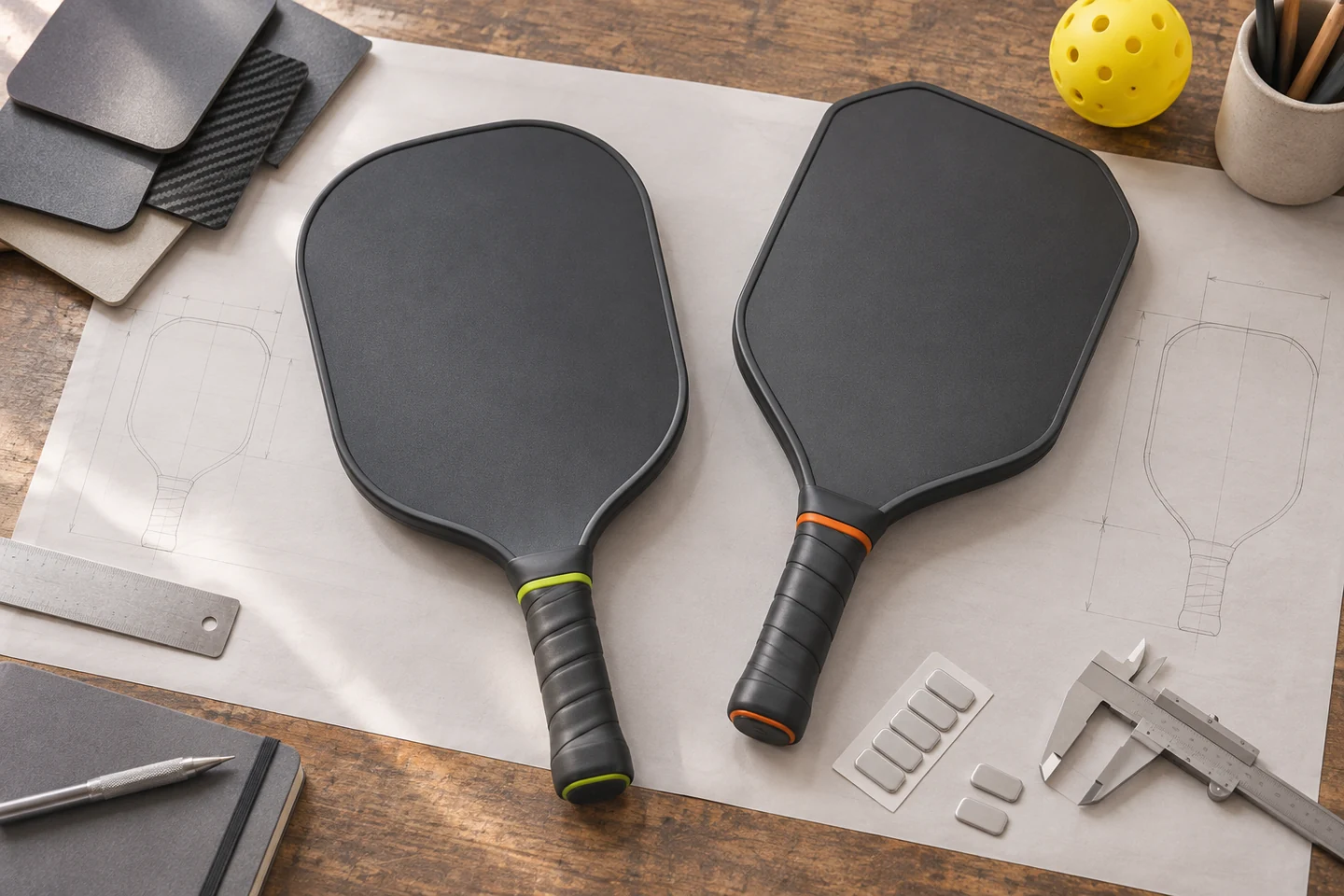
Here is a workflow a brand can use to go from that feedback to a sample request and a specification for pilot production. The example is illustrative. Each project needs its own targets and tolerances.
Identify the shot and the player
Write down who is giving the feedback, which reference paddle they used, and when the problem occurs. A player who struggles in rapid exchanges at the non-volley zone may describe a different issue from someone who wants easier acceleration from the baseline. Ask testers to name the shot and describe the result: a late counter, a twisting block, or a reset that tends to sit too high.
Ask for one positive observation alongside each complaint. In our example, testers would like a quicker counter and want to preserve the reference paddle’s stability on off-center blocks. That gives the team both a design target and a condition to protect.
Record the reference before choosing materials
Identify the model, shape, thickness, grip build, and any added weight. Record finished weight and balance point. If your team can measure swingweight and twistweight consistently, add both values and identify the measurement setup. Swingweight describes resistance to rotation about the swing axis. Twistweight captures resistance to twisting about the paddle’s long axis. A change in mass placement can affect both, which is why a single static weight figure is a limited brief.
Separate measured targets from playtest criteria. Measurements help explain what changed. A set of repeated blocks and counters tells you whether target players prefer the change on court. Compare like-for-like grip configurations and use the same recording method for each sample.
Give each prototype round one job
In round one, build two configurations with the same shape, face, grip, and nominal total weight. Adjust the placement of mass as the comparison variable. Label the paddles A and B and alternate the test order where practical to reduce the effects of warm-up and fatigue. Ask the same players to rate reaction speed on counters and stability on off-center blocks.
After selecting a direction, use the next round to compare an agreed feature such as perimeter construction. Keep a revision log for each difference you introduce. Where a structural change also changes finished mass or balance, record that difference so the result can be interpreted with the right context.
Send a specification the factory can quote
Include a target range or open decision for each of the following:
- Model, shape, dimensions, handle length, and grip circumference.
- Face layup, core and perimeter construction, and surface process.
- Finished weight and balance, plus any agreed swingweight or twistweight criteria.
- Artwork, grip, edge treatment, packaging, and intended approval pathway.
- Reference sample ID, test conditions, and items to confirm before pilot production.
Where a tolerance is still open, ask for what the supplier can measure and hold in repeat runs. A tight number on a spreadsheet needs a measurement method and evidence it can be produced.
Approve a version for the pilot run
Keep an approved sample and its specification together. Agree on the checks for the first small run and what would trigger a retest or a sample revision. Keep subjective feedback in the development record and put measurable acceptance conditions in the production file. This gives the next person a clear way to repeat the decision.
If you have a reference paddle and are working through similar tradeoffs, send the model, target player, and two changes you want to explore to Joying’s OEM and ODM team. Those inputs help us discuss the scope of a first sample.