You can learn more by following one paddle through a factory than by looking at a wall of finished models. Pick a sample close to the paddle you want to sell, then ask the team to show what changed during development, how they identified the approved revision, and how they checked a production batch against it. That gives your team a way to compare suppliers using the same evidence.
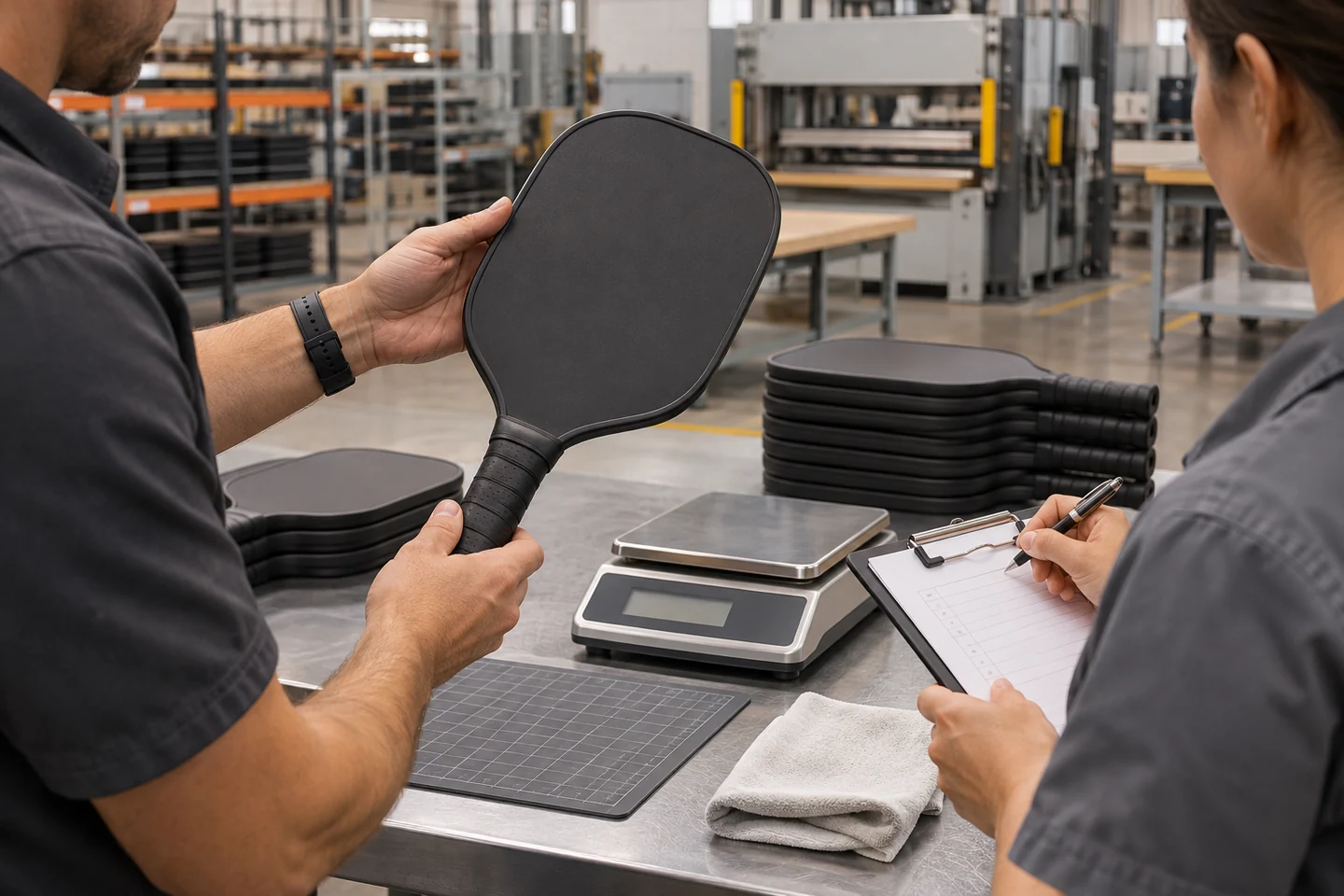
This checklist works for an on-site visit or a video call. Ask to see records the supplier can share, with other customers’ names, designs, and commercial details removed.
1. Send a short brief before the visit
Share the target player, intended price tier, estimated opening order, target launch window, and one or two product priorities. If you have a reference paddle, explain which features you would keep and where you want a change. Ask the factory to prepare a similar sample, a specification sheet, and a sample inspection record. Agree in advance which production steps you can see and which documents you can review.
Leave this step with: a visit agenda that matches your project.
2. Walk through the actual process
Ask which steps happen at the site and which are handled by partners. Follow the path from incoming materials through forming or bonding, trimming, finishing, assembly, and packing, as applicable to the model. At each stop, ask what the operator checks and where a rejected item goes. If a line is idle, ask for a recent redacted work order and a live demonstration of one key inspection.
Leave this step with: a process map showing who controls each operation and who can resolve a quality issue.
3. Trace a sample to its revision
Ask an engineer to walk you through an earlier revision and the current sample. What prompted the change? Which features were held constant? What measurements or playtest feedback led to the decision? The answer can be straightforward. A revision log that connects a change in handle length to an updated drawing and a new sample ID is useful evidence.
Leave this step with: the fields you expect to see on your own sample record, including model ID, revision, date, and open issues.
4. Watch the team check finished paddles
Ask the team to select finished units from a batch and show how they check weight, dimensions, finish, handle assembly, and packaging against a reference. Ask which checks cover every unit and which use a sample of the batch. Discuss optional project checks such as balance or surface evaluation. Agree on the measurement point, tool, tolerance, and procedure for borderline results before ordering.
Leave this step with: a draft inspection plan and the name of the person who approves release.
5. Follow a failed check through to its disposition
Ask for a redacted example of a lot that needed sorting, rework, or replacement. Look for the lot identifier, the failed condition, the decision on affected units, and evidence of a second check before release. For models that will be submitted for equipment approval, also ask how changes to materials or key process steps are reviewed against the submitted configuration.
Leave this step with: a clear escalation route and agreement on which changes require written sign-off.
6. Take a written decision back to your team
Rate each supplier on three questions: Can they make the proposed paddle? Can they show how they will repeat it? Can they communicate clearly when something changes? Mark each point as verified, pending, or unresolved. Request a quotation and sampling plan based on the same brief from each finalist so the next comparison uses a common scope.
Joying owns its paddle factory and works with specialist partners on selected accessories. If you are evaluating a paddle project, share your target player, reference model or design brief, and expected first order through our paddle OEM and ODM page. That gives us a starting point for a conversation about the process, the sample, and what you want to verify before ordering.