
The “Core Crush” Nightmare in Gen 3 Paddles
If you are sourcing Gen 3 (Thermoformed) pickleball paddles, you likely know the biggest risk: Core Crush (also known as delamination or core corruption).
It starts with a subtle “crunchy” sound, followed by a dead spot, and finally, a visible depression in the paddle face. For a brand owner, this leads to a flood of warranty claims and 1-star reviews.
Most factories blame the honeycomb supplier. But at Joying Pickleball, we know the real culprit is the manufacturing process.
Why Standard Thermoforming Fails
In the standard “One-Step” thermoforming process, factories stack the raw carbon fiber, the raw PP honeycomb, and the foaming material into the mold and heat it all at once.
The problem? To bond the carbon fiber and expand the foam, the mold requires high heat and pressure. This intense heat often weakens the thin walls of the polypropylene (PP) honeycomb, making it brittle. When a player smashes the ball, this weakened honeycomb collapses.
Our Solution: The Hybrid Pre-Bonding Protocol
We have re-engineered the Gen 3 production line to solve this. Instead of a single high-stress heating step, we use a 4-Step Hybrid Process that ensures structural integrity before the paddle ever touches the hot mold.
Here is how we do it:
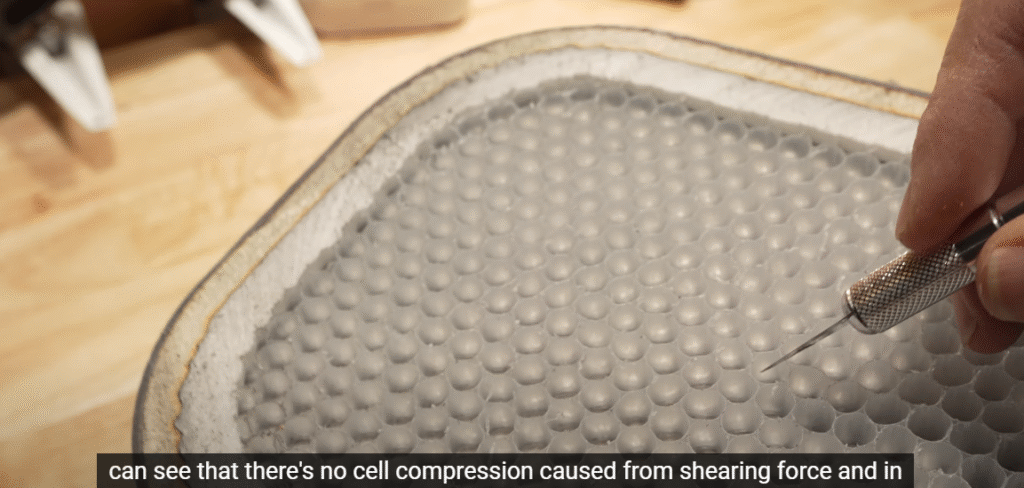
Step 1: Cold Press Pre-Bonding (The Foundation) Before any heat is applied, we use a traditional Cold Press technique to bond the Carbon Fiber sheets to the PP Honeycomb core using high-strength adhesive.
- Why: This creates a rock-solid, permanent bond without subjecting the honeycomb to thermal stress. The core remains 100% intact and strong.
Step 2: Precision Edge Slotting Once the “sandwich” is cured, we use CNC machines to precisely cut a channel (slot) along the perimeter of the honeycomb core.
- Why: This creates a dedicated space for the edge reinforcement, ensuring the foam doesn’t bleed into the honeycomb cells unexpectedly.
Step 3: EVA Foam Injection We fill this edge channel with high-grade EVA Foam.
- Why: EVA foam provides the “suspension” and expanding pressure needed for that Gen 3 power, but because it’s contained in the slot, it supports the edges perfectly.
Step 4: Final Thermoforming (The Seal) Finally, we place the pre-bonded paddle into the hot mold for a short cycle.
- Why: Since the face is already bonded, this step is purely to seal the edges (Unibody construction) and cure the carbon surface. We can use optimized temperatures that seal the paddle without melting or weakening the honeycomb core.
The Result: Gen 3 Power, Gen 1 Durability
By separating the bonding stage (Cold) from the sealing stage (Hot), we offer:
- Zero Core Crush: The honeycomb retains its original structural strength.
- No Delamination: The cold-press bond is notoriously stronger and longer-lasting than heat-fused bonds.
- Consistent Performance: No dead spots caused by heat-damaged core areas.
Stop Gambling with Your Warranty Rate
Your brand shouldn’t have to choose between the performance of a Thermoformed paddle and the reliability of a Cold Pressed one.
At Joying Pickleball, we give you both.